
Dhabi's Masdar Institute of Science and Technology -- an independent, non-profit institution -- will conduct the study alongwith Boeing and Yale University's School of Forestry and Environmental Studies, to examine the possibility for sustainable, large-scale production of biofuel from halophyte plants like salicornia bigelovii and saltwater mangroves.

Dr Seshadri Ramkumar, associate professor, Institute of Environmental and Human Health, Texas Tech University, has been honoured as Scientist of the Year, 2009, by the Lubbock Chapter of Achievement Rewards for College Scientists."Normally, very senior scientists who have reached national prominence get the honour," Ramkumar said. "This time, they were gracious to recognise me for my successful result using the nonwoven wipe and its technology transfer."

The OTT glass is full again. Here's all the exciting new fare to watch over the week. Sukanya Verma offers a peek.

'You can have a bath in just one bucket of water.' 'When you are brushing your teeth, remember to turn off the tap.' 'You don't have to wash your car every day.'

The arrival of summer in India may have raised hopes that hot and humid weather could slow the COVID-19 progression but virologist Naga Suresh Veerapu believes that outbreak and pandemic occurrences often do not follow seasonality.

'Everything is possible if you are willing to give it your best shot.' 'And while you go about achieving your dreams, don't forget to care for our planet.'

The study revealed that the rise in temperatures leads to a decline in the transmission of the virus.

'There are fossils to indicate that there has been a gradual evolution of various body parts leading to very complex organisms like vertebrates, apes and humans.'

'Ignorance isn't a problem when it's a question of common citizens having forgotten (or never learnt) middle school science.' 'It becomes a problem when it's displayed by policymakers and people of some influence,' says Devangshu Datta.

'But one of the important things to remember is that what we are seeing today in India -- the destruction of the forests, the opening up of the forests to mining companies.' 'It's a horrifying thing that's going on.' 'Yet, if you look at who owns the mining companies, you will see that almost always they are vegetarians!' 'They are people, who in their own lives would probably not even hurt an insect, but yet have no qualms about destroying an entire ecosystem.'

The new malaria vaccine (RTS.S/ AS01, tentatively brand-named Mosquirix) is the very first one to offer immunity against a parasite -- specifically the plasmodium falciparum parasite, which is the deadliest of the five parasites that cause malaria.

Nikita Puri introduces the Indian teenager who has joined the league of innovators with celestial bodies named after them.

Delhi's air quality was again in the severe category with the 24-hour average AQI recorded at 403 after remaining in the 'very poor' category till Tuesday morning, when the AQI was recorded at 396.

Overseas education consultant NNS Chandra offers advice.

Whenever you think of Microsoft, the only name that crosses one's mind is Bill Gates. But the tech behemoth was co-founded in 1975 by Gates and Paul Allen.

'If you weed out corruption, you will bring glory to Goa.'

'We don't know if the water we are drinking has lead in it or not.' 'In India, we don't have ways to easily detect or measure contamination levels.'
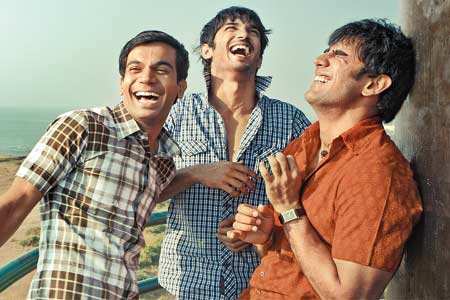
Friendships developed as kids can actually benefit your health.

'Gandhi turned his life into a counter-intuitive experiment in old ideas like non-violence and swadeshi.' 'He offered numerous universal ideas that talk to the human condition.' 'His ability to take risks was outstanding,' says Sopan Joshi, explaining why the Mahatma's ideas are as relevant as ever.

There can be no one answer to the question at the centre of an anxious debate across a world coping with COVID-19 and wondering what will happen if another one comes, but the global scientific community has been working on multiple tracks to ensure that humankind is better prepared.

President Ram Nath Kovind presented Padma awards to 73 individuals, some posthumously, at a ceremony held in the Rashtrapati Bhavan here on Monday.
Magsaysay Award winner Sonam Wangchuk speaks to Claude Arpi about his journey, his fights, his hopes and how he became an inspiration for the Bollywood blockbuster.

Anjuli Pandit wants to use her skills to educate more and more Indians, says Chaya Babu

Intel's Young Scientist Karan Jerath talks about inventing, innovating and life.

These tips will help you excel in the competitive exam.

The Forbes 5th annual '30 Under 30' list features 600 women and men.


Santosh Kaveri, a young inventor from Karnataka, is a sterling example of the 'Made In India' initiative. Find out why his dreams of being an innovator-enterpreneur shattered.

Gargi Vijaraghavan feels that the human species is a bigger danger to her beloved snakes.

Pollution is not merely the price to be paid for growth; it is also a drag on the same growth.

The Society of Asian American Scientists in Cancer Research last month presented awards to seven doctors for their outstanding contributions to cancer research. The awards were presented by Rajvir Dahiya, SAASCR president, San Diego, California on April 6.
'Two have already sacrificed their lives.' 'How many more shall need to sacrifice before the government listens?' 'Four, five or six? They are ready, waiting.' After Ganga campaigner G D Agrawal's death, a Haridwar ashram's sadhus are on a relay fast unto death.

Meet Sabriye Tenberken, a German woman who is changing lives in India.

'Please don't celebrate me if you are not going to listen to my voice.'
Delhi is a year-round health hazard that visitors shun like the plague, says Sunil Sethi.

We sorted through countless photographs taken around the world to come up with the top photos of 2019. Together these images tell the story of the year -- capturing moments of hope and heartbreak, triumph and tragedy.

'It is very important for Indian Americans to understand that we need to have as many seats at the table as we can get. I am going to see to it that I am going to get there," Kumar Barve, the longest-serving Indian-American legislator in America, tells Aziz Haniffa/Rediff.com in an exclusive interview.

While India is pushed to keep a tight lid on its own carbon emissions, slow and low emission reduction by major polluters will cause an acceleration of climate change, says Rajni Bakshi.

'This is not a Sanjay Baru or Natwar Singh type of book. It's not a memoir. It's not a book to reveal conversations, real or imaginary. This is not a book to position myself at the centre of the world.' Jairam Ramesh on his stint as environment minister.

Do you have the ability to speak up and lead by example?
 © 2026 Rediff.com - Advertise with us - Disclaimer - Privacy Policy - Sitemap - Feedback - About us - Terms of use - Grievances